Software Missions

Orbital Software
Rideshare Mission

Flight heritage and on-orbit validation for software and compute technologies

Blackwing Space is preparing an orbital software demonstration mission for startups, commercial technology companies, research organizations, and other teams developing software, AI, autonomy, edge compute, and related space applications.

The mission will host multiple independent software payloads aboard a Blackwing Sparrow nanosatellite equipped with the Blackwing Space CM5 Payload Module, powered by the Raspberry Pi Compute Module 5 (CM5). Parsimoni SpaceOS will provide the primary payload application environment for software integration, deployment, management, and execution in orbit. Targeted for launch to low Earth orbit in Q3 2027, the mission is intended to provide a low-cost, structured path to flight heritage without requiring each participant to develop and operate a complete satellite mission.
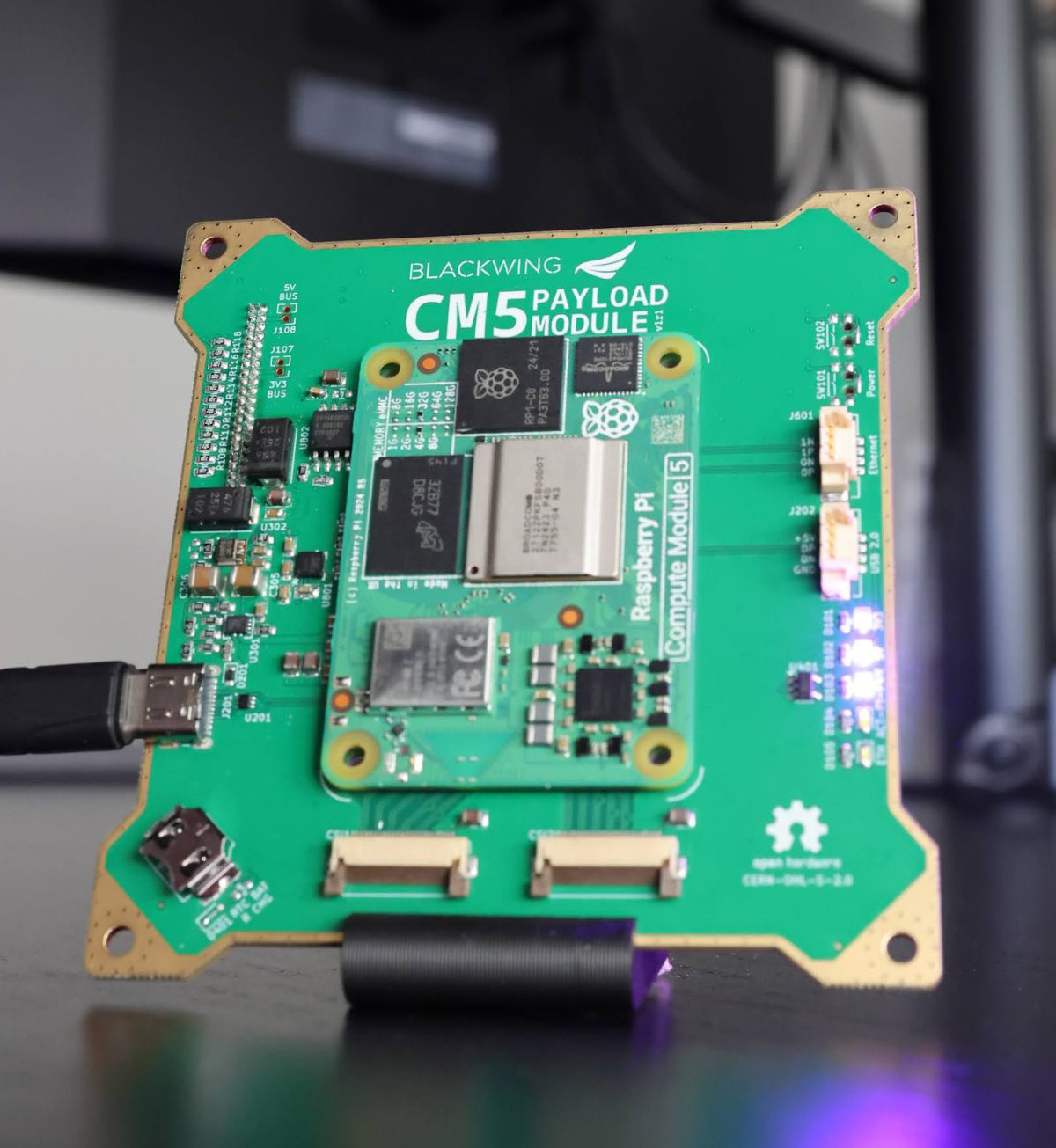
Blackwing Space CM5 Payload Module
Blackwing Space
Sparrow 2U
Host Platform
Raspberry Pi
CM5
Compute Hardware
NET
Q3 2027
Target Launch Period

A Practical Path to Software Flight Heritage

Software and compute technologies can be developed and extensively tested on the ground, but many applications ultimately require validation in the operational space environment. Obtaining that flight heritage remains expensive and operationally complex, particularly for early-stage companies and technology teams that do not require an entire satellite.

Blackwing Space's orbital software rideshare mission addresses this gap by hosting multiple independent software workloads on a single mission. Participants receive a defined pathway from ground development and technical qualification through flight integration, scheduled on-orbit execution, and delivery of agreed mission data and evidence of execution.

Edge AI and machine-learning inference:
Model execution and validation on flight compute.

Autonomous satellite applications:
Onboard autonomy operating against live satellite systems.

Earth-observation and sensor-data processing:
Onboard processing of mission data streams.

Data compression and reduction:
Reducing downlink demand ahead of transmission.

Cybersecurity and cryptographic applications:
Encryption, signing, and security experiments in orbit.

Middleware and orchestration:
Scheduling and application-management technologies.

Fault detection and management:
Onboard health monitoring and fault-response software.

Software-defined sensor processing:
Data fusion and analytics using approved mission sensors.

Application frameworks and developer infrastructure:
Tooling, observability, and remote configuration technologies.

Satellite, Compute, and Software Environment

Customer software executes in a familiar ARM-based commercial computing environment, hosted on a Blackwing Space nanosatellite and managed through a purpose-built orbital application environment provided by Parsimoni.

Blackwing Space Sparrow

Host Platform

The Sparrow nanosatellite platform provides power, communications, command and telemetry, and hosting for the onboard CM5 compute payload. Blackwing Space manages satellite integration, regulatory licensing, launch integration, and on-orbit operations.

CM5 Payload Module

Onboard Compute Hardware

Customer software executes on the Blackwing Space CM5 Payload Module, an onboard compute payload based on the Raspberry Pi Compute Module 5. The CM5 operates as a scheduled, duty-cycled compute resource within the nanosatellite's available power, thermal, communications, and operational constraints.

Parsimoni SpaceOS

Application Environment

SpaceOS serves as the primary payload software deployment and application-management environment, providing secure isolation and management of multiple independent customer workloads. Alternative deployment approaches may be considered where required and approved during qualification.

Execution Against Real Satellite Systems

The objective is to provide participants with an operational environment in which software can be executed against satellite systems data generated during actual on-orbit conditions. Approved workloads may receive access to mission data including:

  • Satellite platform power, thermal, and system health telemetry data
  • Onboard sensor data from an Earth imaging system (to be confirmed)
  • GNSS-derived satellite position and velocity vectors
  • Filtered attitude quaternions and body rates

Final compute allocations, execution windows, storage, communications capacity, API permissions, and available sensor data will be established during technical qualification and mission integration.

What Participation Includes

Each accepted software payload receives a defined mission allocation and integration pathway that includes:

  • Technical qualification and compatibility review
  • Access to the SpaceOS development workflow
  • Defined compute, memory, storage, runtime, and data allocations
  • Flight acceptance review
  • Scheduled on-orbit deployment and execution
  • Access to approved satellite telemetry and mission data
  • Delivery of agreed workload logs, outputs, and evidence of execution
  • Mission operations support
  • Agreed rights to reference participation and resulting flight heritage

Program Milestones

  • Q3–Q4 2026
    Reservations and Technical Qualification

    Application review, confirmation of technical fit, and reservation of mission slots.

  • Q4 2026 – Q1 2027
    Customer Development and Onboarding

    Development workflow, defined allocations, software packaging and testing.

  • Q1–Q2 2027
    Software Integration and Flight Acceptance

    Compatibility, security, and mission-readiness reviews; flight software versions frozen.

  • NET Q3 2027
    Target Launch Period

    Satellite integration, launch processing, and launch campaign activities.

  • Q3–Q4 2027
    Commissioning and On-Orbit Software Operations

    Workload deployment, execution of run plans, downlink of results, and mission closeout with agreed data and reports.

Schedule subject to change. Mission schedule remains subject to launch provider readiness, satellite integration, regulatory requirements, and mission readiness.

Securing a Mission Slot

Reservation

Participation begins with a $5,000 refundable reservation, which initiates technical qualification. The reservation remains refundable until technical acceptance and execution of the definitive payload agreement, at which point it is applied toward the mission price.

Technical Qualification

Blackwing Space and Parsimoni review the proposed workload, resource requirements, software architecture, data requirements, security considerations, and mission objectives to determine compatibility with the mission.

Integration and Flight

Accepted payloads proceed through onboarding, integration, and flight acceptance to scheduled on-orbit execution, with delivery of agreed mission data and evidence of execution.

The mission will accommodate a limited number of software payloads.

Partners and Responsibilities

Blackwing Space: Satellite Provider and Mission Operator

Blackwing Space provides the Sparrow nanosatellite platform, CM5 compute payload, satellite integration, launch services, mission licensing, ground systems, and mission operations services.

Parsimoni: Mission Software Integrator

Parsimoni is the provider of SpaceOS and supports the customer software development workflow, workload onboarding, integration, deployment, and application management.

Build a CubeSat: Hardware Partner

The Blackwing Space CM5 Payload Module is developed in partnership with Build a CubeSat and released as open-source hardware.

Mission FAQ

Common questions from prospective mission participants. <
For anything not covered here, email the mission team.

Startups, commercial technology companies, research organizations, and university teams developing software, AI, autonomy, edge-compute, or other software-defined space technologies that require flight heritage or on-orbit validation without the cost and complexity of developing and operating a dedicated satellite mission.

One hosted software payload allocation on the shared mission includes: technical qualification and compatibility review, access to the SpaceOS development workflow, defined compute/storage/runtime/data allocations, flight acceptance review, scheduled on-orbit deployment and execution, access to approved telemetry and mission data, delivery of agreed logs and outputs as evidence of execution, mission operations support, and agreed rights to reference participation and the resulting flight heritage.

A hosted software payload slot is $20,000. Participation begins with a $5,000 refundable reservation that initiates technical qualification. The reservation remains refundable until technical acceptance and execution of the definitive payload agreement, at which point it is applied toward the mission price. Reserve a slot here.

Yes. The reservation remains refundable until technical acceptance and execution of the definitive payload agreement. If a participant's software cannot be made flight-ready in time for this mission, the reservation may be applied toward a future Blackwing Space software mission.

Customer software executes on the Blackwing CM5 Payload Module, an onboard compute payload based on the Raspberry Pi Compute Module 5 (quad-core Arm Cortex-A76). The platform supports Raspberry Pi OS, native Python, and approved application deployment environments, with Parsimoni SpaceOS as the primary deployment and application-management environment. The CM5 operates as a scheduled, duty-cycled compute resource within the satellite's power, thermal, communications, and operational constraints.

Approved workloads may receive access to satellite platform power, thermal, and system health telemetry; onboard sensor data from an Earth imaging system (to be confirmed); GNSS-derived satellite position and velocity vectors; and filtered attitude quaternions and body rates.

You will need hardware to develop and test on: a commercially available Raspberry Pi Compute Module 5 (CM5), the same compute your workload flies on. Blackwing Space provides the hardware specifications and Parsimoni provides a software SDK that includes the SpaceOS environment and API tools, so your ground configuration mirrors the flight configuration.

The mission is targeted for launch no earlier than (NET) Q3 2027 aboard a commercial rideshare mission. The launch date and mission schedule are subject to change.

Mission closeout includes delivery of agreed data, reports, and evidence of on-orbit execution supporting the participant's flight-heritage record. Participants may then pursue follow-on missions, larger compute allocations, dedicated satellites, or constellation deployment with Blackwing Space.

Now Accepting Reservations

Blackwing Space is currently accepting applications and reservations for the Q3 2027 orbital software rideshare mission. Organizations developing software, AI, autonomy, edge compute, or other software-defined space technologies are invited to review technical requirements and determine mission compatibility with the mission team.