Compute Payload

Raspberry Pi CM5.
Edge compute for space missions.

A flight-ready compute payload for the Sparrow 1U platform — Linux on ARM, Docker-friendly, designed so software teams can run their code in orbit without designing a compute board from scratch. Open hardware. Targeting Q3 availability.

Edge Compute Onboard Processing AI/ML
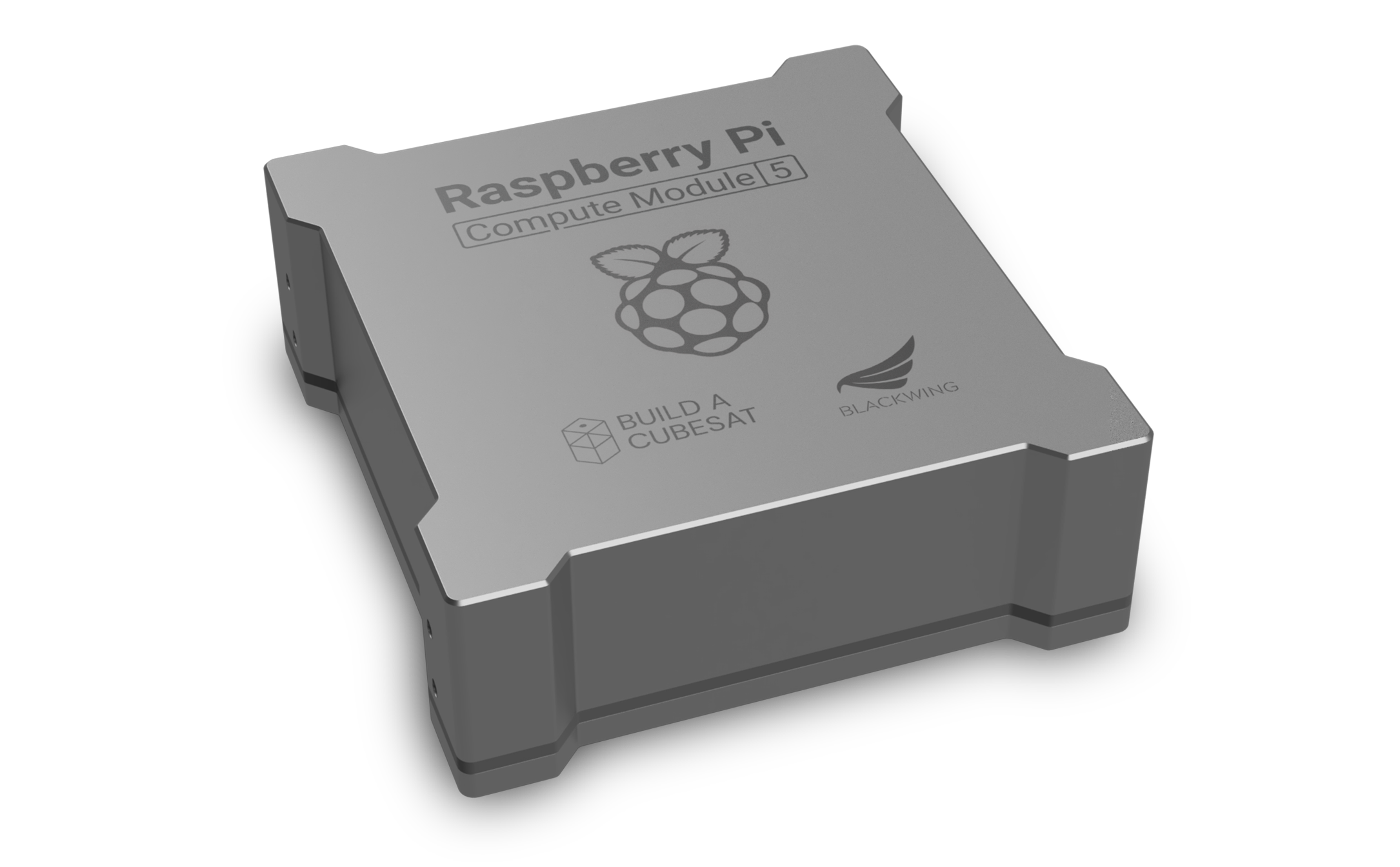
CM5
Compute Core
2.4GHz
Quad Cortex-A76
16GB
Max LPDDR4X RAM
64GB
Max eMMC Storage
Various
Software Stack

Preliminary Specification

These specifications are preliminary and subject to change. Final electrical, mechanical, thermal, and software limits are confirmed at integration review. Higher-power workloads, certain sensor configurations, or custom integrations may require a larger platform or customer-supplied modifications.

Cheap, fast, familiar — and proven.

NASA JPL's 2021 guidance found the CM4 already outperformed nearly every rad-hardened space computer under $250K. The CM5 is roughly 3× that. With a hardware watchdog, redundant boot, and reboot-tolerant software, it is a practical option for orbital workloads — at a fraction of traditional space-grade pricing.

Cost

A radiation-hardened space processor typically starts at tens of thousands of dollars. The CM5-based approach delivers practical on-orbit compute at a fraction of that — sometimes less than the cost of a single rad-hard chip.

Performance

Cortex-A76 cores deliver ~3× the throughput of the CM4. Hardware AES is 12–19× faster. Suitable for TensorFlow Lite, ONNX, MobileNet, YOLOv5-nano, time-series anomaly detection, and small quantised LLMs at the edge.

Flexibility

Standard Raspberry Pi OS. Python runs natively. Docker for containerised workloads. Build locally, test on a $130 CM5 dev kit, deliver a container image. If it runs on a Pi, it can run on orbit.

Compute Window

Sparrow's 10 W orbit-average envelope gives roughly 20–40 minutes of active compute per 90-minute orbit — a predictable scheduled compute window that repeats 16× a day. Design your software around that.

CM5 Payload Module — Sparrow 1U

Based on the Blackwing Space CM5 Payload Module specification. Final electrical, mechanical, thermal, and software limits are confirmed during integration review.

Compute Module
  • CM5 SoC: Broadcom BCM2712, quad-core Arm Cortex-A76 @ 2.4 GHz, ARMv8 64-bit
  • RAM options: 2 GB, 4 GB, 8 GB, or 16 GB LPDDR4X-4267
  • eMMC options: Lite / 0 GB, 16 GB, 32 GB, or 64 GB
  • Persistent memory: Onboard FRAM planned for small, durable mission state (counters, checkpoints, fault history). Final capacity TBD.
  • Wireless: N/A. Disabled on orbit.
Sparrow OBC Interface
  • Connector: Sparrow 40-pin payload connector (only interface to OBC)
  • I²C: One 3.3 V bidirectional I²C interface to Sparrow avionics
  • SPI: One 3.3 V bidirectional SPI interface, driven by the Rook motherboard
  • UART: One 3.3 V bidirectional UART interface, optional flow control
  • GPIO: Two 3.3 V GPIO lines, subject to final pin-map review
Local Payload Interfaces
  • USB 2.0: 1× host port for local peripherals, debug, or payload devices
  • Ethernet: 10/100 Ethernet via PicoBlade for integration / debug workflows
  • CSI camera: Up to 2× MIPI CSI-2 camera interfaces — imaging, optical sensing, computer vision
  • PCIe: 1× PCIe Gen 2 ×1 via M.2 Key M 2242 — NVMe storage or compatible peripherals
Power & Thermal
  • Idle current: ~400 mA typical (OS-dependent)
  • Operating current: ~900 mA typical, design for up to 2.5 A peak per CM5 datasheet
  • Shutdown current: ~1.3 µA with PMIC_EN low
  • Thermal path: Sparrow chassis is the primary heat path to space
  • Operating range: −20 °C to +85 °C
Software & Operations
  • Default OS: Raspberry Pi OS (Debian-based, ARM64)
  • Alternatives: Raspberry Pi OS Lite · Avocado OS · Debian ARM64 · Alpine Linux · custom Yocto builds
  • Runtime: Python runs natively · SpaceOS or Docker for containerised payloads · C/C++/Rust for performance work
  • Compute model: Scheduled compute node, ~TBD min of active processing per 90-min orbit, near-zero draw otherwise
Option: SpaceOS (Partner)
  • Platform: Parsimoni SpaceOS - secure-by-design OS
  • In-orbit: Deploy, update, and manage multiple software packages on orbit
  • Multi-payload: Multiple customer payloads per mission, single satellite to constellations
  • Commercial: No-upfront and low monthly service-fee models

Mission Applications

A practical compute envelope for software-first space teams. Run AI inference, prep Earth-observation data, filter the downlink, validate code in real LEO conditions — all from a familiar Linux-on-ARM environment with Docker, Python, and the rest of your existing toolchain.

Edge AI Inference

Run lightweight ML inference at the edge: TensorFlow Lite, ONNX Runtime, MobileNet, EfficientNet-lite, YOLOv5-nano, and small quantised LLMs. CPU-first within the 10 W envelope — no GPU, NPU, or FPGA onboard by design.

Earth Observation Pipelines

Capture and pre-process imagery onboard via up to 2× CSI cameras. Generate analysis-ready EO data in orbit instead of routing raw bytes through the ground station and processing on the ground.

Onboard Compression & Filtering

Cut downlink volume by compressing payload data and filtering events before transmission. Especially valuable for image-heavy and high-rate-sensor missions where ground bandwidth is the bottleneck.

Event & Anomaly Detection

Time-series anomaly detection, threshold triggers, and change-detection running on sensor streams. Downlink only what crosses an event boundary instead of streaming continuously.

Secure Downlink & Crypto

Hardware AES on the CM5 is 12–19× faster than CM4 — encrypt downlink, sign telemetry, or experiment with post-quantum primitives onboard without burning the power budget.

Flight-Heritage Your Software

Validate code in real LEO conditions without building a dedicated mission. Earn flight heritage for an algorithm, model, or framework as a hosted payload on a single Sparrow mission.

Containerised Workloads

Run multiple software payloads on one mission via SpaceOS or Docker. Blackwing's base layer handles health monitoring, power-state transitions, and radio access; your containers run within defined resource limits.

Sensor Fusion & Custom Payloads

Combine CSI cameras with CM5-local sensors (I²C, SPI, UART, USB, PCIe NVMe) into unified data products. Suitable for science instruments, SDR experiments, and multi-modal observation payloads.

Frameworks & Stacks supported: Raspberry Pi OS · Raspberry Pi OS Lite · Debian ARM64 · Alpine Linux · Python · C/C++/Rust · SpaceOS · Docker

Documentation & Reading

Read the developer guide, datasheet, and product announcement — plus the long-form article on space compute economics.

Compute Module Announcement

Blackwing's product announcement introducing the Raspberry Pi CM5 payload module for Sparrow.

Read announcement
Raspberry Pi CM5 Datasheet

The official Raspberry Pi Foundation datasheet for the Compute Module 5 — SoC, electrical, mechanical, and pinout specifications.

Open datasheet
Payload Spec & Developer Guide

Blackwing's CM5 Payload Module specification and software developer guide — Sparrow connector, interfaces, software workflow, and reliability practices.

Read the guide
Raspberry Pi CM5: Space Compute on a Budget

The Blackwing Space article on why Raspberry Pi-class hardware makes sense in orbit, with flight heritage from GASPACS and SatGus, and what the CM5 enables for software-first space teams.

Read article

Raspberry Pi Flight Heritage.

Raspberry Pi-class hardware has already flown on several missions. Public flight results and independent radiation testing show the path to a LEO tech demo is well established.

GASPACS (2022)

NASA-sponsored 1U CubeSat by Utah State University. Raspberry Pi Zero flight computer, Python flight software. Lasted 117 days and survived multiple X-class solar flares that destroyed every other CubeSat deployed alongside it.

SatGus (2025)

CrunchLabs / Tyvak 12U CubeSat with a Pi Compute Module 4 managing payload. CM4 tested at UC Davis to 57.8 kRads — roughly 6 years equivalent LEO exposure. Simple aluminum enclosure.

NASA JPL Bound

JPL's published cosmic-ray reboot rate for Pi-class hardware in low-inclination LEO: once every 100 days (upper bound), likely once every 300 days in practice. TID survivability: at least 5 years.

Plan a CM5 mission.

Configure your Blackwing platform, then talk to the payload team about aligning the Raspberry Pi CM5 module with your mission requirements. Targeting Q3 availability — early partner discussions underway.