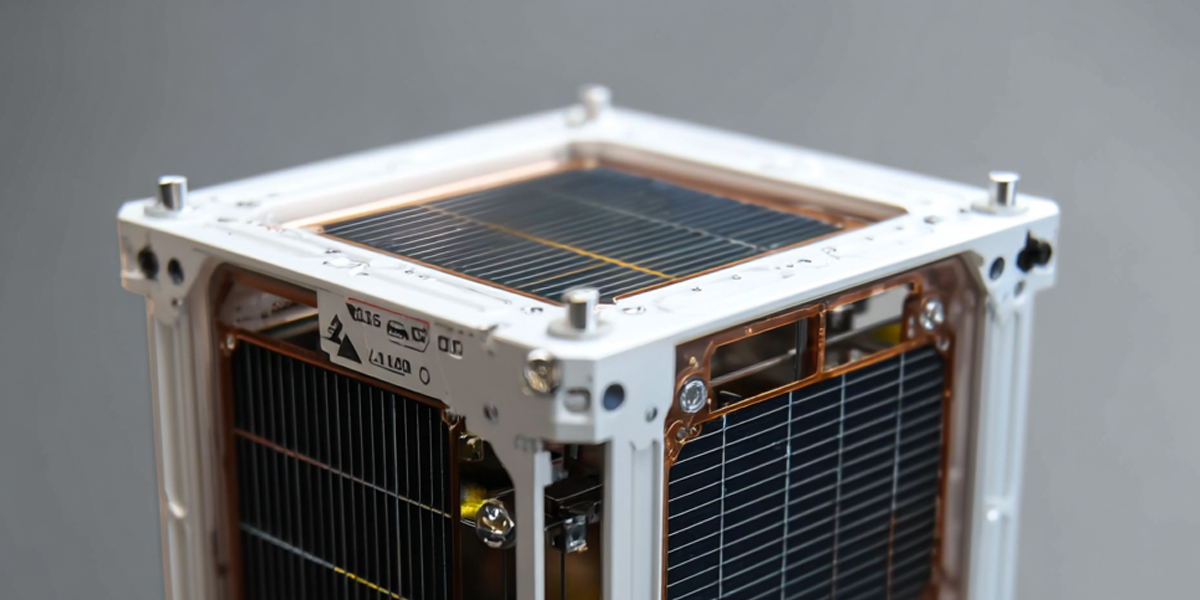
CubeSat Platform for Sale: A Buyer's Guide to Comparing Bus Specifications Side-by-Side
A practical worksheet for comparing competing CubeSat platform quotes on the numbers that actually determine mission fit.
When more than one manufacturer quotes a CubeSat platform for the same mission, the quotes rarely arrive in a comparable format. One vendor leads with peak power, another with average power at an unspecified orbit. One quotes payload mass as a percentage of total bus mass, another as an absolute number. Comparing these documents side by side without normalizing the numbers first is a common way buyers end up selecting a platform that looks competitive on paper and turns out not to fit the mission.
One Table Instead of Three Quotes
The fix is mechanical: before evaluating any quote on price or vendor reputation, it helps to transfer every technical claim into a single comparison table with identical rows for every vendor. The rows that matter most for mission fit are orbit-average power at your specific orbit and attitude profile, three-axis pointing accuracy in degrees, usable payload volume in U, usable payload mass in kg, downlink data rate and frequency band, and total mass of the fully integrated bus. Any vendor quote that does not supply a number for one of these rows is a good candidate for a direct follow-up question before it is scored.
Normalizing Power Numbers
It is a good idea to ask every vendor for orbit-average power, not peak, and to specify the orbit (altitude, inclination, and whether sun-synchronous) you intend to fly. Power generation on the same panel area can vary by 30 percent or more between a dawn-dusk sun-synchronous orbit and a mid-inclination orbit with regular eclipse periods, so a number quoted without an orbit assumption is not comparable across vendors unless you confirm they used the same assumption.
Normalizing Payload Allocation
Payload volume and mass are most useful when requested as absolute numbers specific to the configuration being quoted, not as a percentage of the chassis size class. A 3U bus with a 1.5U payload allocation and a 3U bus with a 1U payload allocation are both legitimately described as 3U platforms, but they are not interchangeable for a payload that needs the larger volume. The same logic applies to mass: a payload mass budget in kilograms, after subtracting structure, power, avionics, and any fixed antennas or deployables, is the number worth asking for.
Pointing Accuracy and Downlink: Match to Payload, Not to Price
It is tempting to treat pointing accuracy and downlink rate as places to save cost if your mission does not obviously need the higher-tier options. Confirming this against your actual payload requirements, rather than assuming, avoids an expensive surprise. An imaging payload, a laser communications terminal, or any payload requiring precise ground-track pointing needs sub-degree accuracy; a radio relay or environmental sensor payload usually does not. Downlink rate matters in direct proportion to how much data your payload generates per orbit; a 9.6 kbps UHF link that is fine for telemetry can take days to return imagery.
Using the Table to Negotiate, Not Just Compare
Once the table is filled in with normalized numbers, it becomes a negotiating tool, not just a comparison. If one vendor's quote has a materially better pointing accuracy at a similar price to a competitor's coarser ADCS package, that is useful leverage. If a vendor is unwilling to put a specific orbit-average power number in writing after you have supplied your target orbit, that is useful information about how firm the rest of their quote is likely to be.
Blackwing Space's own Baby Bird mission quote, for context, specified a Sparrow 1.5U bus with a defined orbit (sun-synchronous, approximately 520 km, 97.4 degrees inclination) and a UHF downlink, numbers that were fixed early enough in the program to support payload integration planning for three separate commercial customers. That is a useful standard to compare any vendor against: specific numbers, tied to a specific orbit, in writing, before a purchase decision is made.
Lead Time and Total Cost Belong in the Same Table
Price comparisons go wrong when they compare sticker price alone. Two more rows in the same table help: lead time from order to delivery, and total cost including any items commonly quoted separately, such as ground station access, licensing support, or integration hardware for a specific launch vehicle. A platform quoted at a lower unit price but a longer lead time, or with several support services unbundled and priced separately, can end up costing more in total than a higher sticker-price quote that includes those items. Scoring every vendor against the same six technical rows plus lead time and total cost turns a stack of incomparable PDFs into a decision you can actually defend to a funding partner or a board.

Related Articles