PyCubed: Empowering the Next Generation of CubeSats with Open-Source Innovation
An In-Depth Look at the Radiation-Tested, Python-Programmable Platform That's Democratizing Space
In the rapidly evolving world of small satellites, PyCubed stands out as a game-changer. This open-source platform is designed to make CubeSat development faster, cheaper, and more accessible, especially for educational and research missions. By leveraging commercial off-the-shelf (COTS) components with careful radiation testing and a Python-based software stack, PyCubed lowers the barriers that have historically plagued first-time satellite builders, where failure rates can approach 60%.
History and Origins
PyCubed was born out of the need for a reliable, user-friendly avionics system for CubeSats. It originated at Stanford University as the core motherboard for the KickSat-2 mission in 2018-2019. Developed by researchers including Max Holliday and Zac Manchester (now at Carnegie Mellon University's Robotic Exploration Lab), the project drew inspiration from successful open-source ecosystems in drones and robotics. The goal was to create a "Careful COTS" approach: using affordable commercial parts vetted for space environments rather than expensive radiation-hardened alternatives.
The platform has since evolved, with contributions from institutions like NASA, the University of Washington, and Carnegie Mellon. Its open-source nature, licensed under MIT and CERN OHL, has fostered a community-driven model, with all design files, documentation, and software available on GitHub (github.com/pycubed). While repository activity has slowed in recent years, key updates continue, such as the 2024 radiation sensitivity notice for its microcontroller.
Key Features and Hardware Architecture
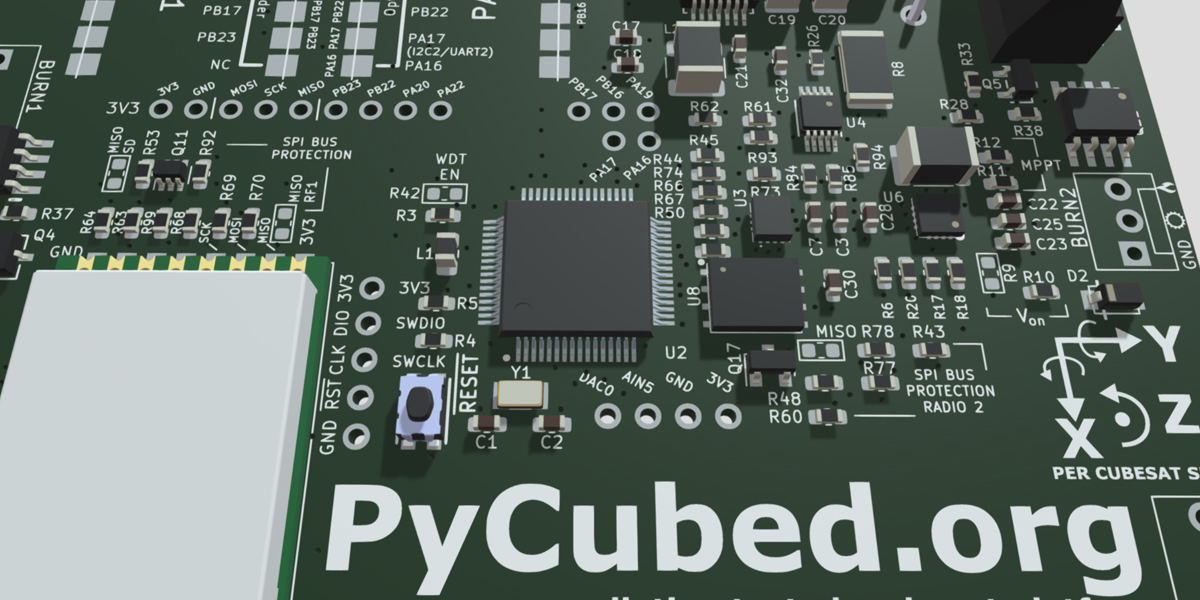
PyCubed integrates multiple subsystems into a single PC104-sized (roughly 9x9 cm) 4-layer PCB, making it ideal for 1U to 6U CubeSats. Here's a breakdown of its core components:
- Component
- Description
- Key Specs
Microcontroller
- ATSAMD51 (ARM Cortex-M4)
- 120 MHz, 1MB Flash, 256KB RAM; flight heritage on missions like EQUiSat. Note: Versions v00-v05 show proton sensitivity; v06 will replace it.
Power Management
- DC-DC converters (TPS542XX) with MPPT for solar
- TID tolerance 15-20 krad; supports battery charging and monitoring.
Memory
- MRAM (MR25H40) + microSD slot
- TID 90-100 krad; Delkin U1000 SD for radiation resilience.
Communications
- Modular radio slots (e.g., RFM9x LoRa)
- Supports UHF, LoRa (433/915 MHz); UART/SPI/I2C interfaces.
Attitude Determination & Control (ADCS)
- Integrated sensors
- IMU, magnetometer, sun sensors; GaN Hall-effect for magnetic fields.
Other
- Watchdog timer, deployment system
- External MAX70X (TID ~11 krad); burn wire with relay for safety.
The board uses low-CTE materials (FR408HR PCB) to withstand thermal cycling (-20°C to +100°C) and mechanical stress. Radiation testing (per MIL-STD-883) confirms tolerance for LEO missions, with simulations showing <10 krad TID over a year with minimal shielding.
Variants include the original PyCubed and the compact PyCubed-Mini, plus a PocketQube version (PyCubed-1) for even smaller form factors.
Software Framework: Python in Space
What sets PyCubed apart is its software: fully programmable in CircuitPython (a MicroPython fork). This means:
- No Compilation Needed: Code as .py files on a USB-accessible drive.
- Hardware Abstraction: Easy access to peripherals via libraries (e.g., library_pycubed.py).
- Fault Tolerance: State-machine architecture with auto-recovery and watchdog reboots.
- OTA Updates: Reconfigure missions mid-flight.
- Simplicity: Beginners can implement sensor data collection, comms, and control in under 15 lines of code.
This Python-centric approach drastically reduces development time compared to traditional C/C++ RTOS, making it perfect for students and rapid prototyping.
Flight Heritage and Missions
PyCubed has proven itself in real space environments:
- KickSat-2 (2019): A 3U CubeSat that deployed over 100 femtosatellites in LEO (300-375 km). PyCubed handled avionics, data collection, and power - accumulating just 34 rad(Si) dose with no failures.
- PY4 (2024): A NASA-funded swarm of four 1.5U CubeSats launched March 4, 2024, on SpaceX Transporter-10. Demonstrated mesh networking, inter-satellite ranging, and formation flying. Despite some reboots (linked to ATSAMD51 sensitivity), it achieved baseline goals. PY4-4 decayed December 24, 2024; others ongoing.
- V-R3X: No reported issues with ATSAMD51; details sparse but confirmed successful.
- PandaSat: Stanford-related mission for tech demo.
- PyCubed-1 (PocketQube): Miniature version for ultra-small sats.
Over 10 missions have used PyCubed variants, per community reports, with ongoing adoption in university programs like Stanford's capstone courses.
Community and Resources
PyCubed's GitHub org (pycubed) hosts repos for hardware designs, software examples, libraries, and docs. While activity has waned (last major updates 2022-2024), forums and the pycubed.org site provide quick starts and discussions. The August 2024 notice on proton sensitivity highlights ongoing testing, with v06 boards addressing issues.
Documentation includes engineering justifications, qualification data, and hands-on guides. It's integrated with tools like COSMOS for ground control and has inspired forks for custom applications.
Challenges and Future Directions
Recent testing revealed ATSAMD51 vulnerabilities to protons (latch-ups at low fluences), leading to reboots in PY4. Future iterations will swap the MCU while retaining the rest of the radiation-resilient bus. As CubeSats push into more demanding orbits, PyCubed's "fail fast, learn faster" ethos - bolstered by open-source iteration - positions it for growth.
PyCubed exemplifies how open-source can democratize space, much like Moore's Law has for other tech. Its affordability (~$400-600 per board) and simplicity are unlocking innovations for startups and educators worldwide.
At Blackwing Space, we're building on this foundation with our ROOK On-Board Computer (OBC). Based on PyCubed, ROOK incorporates improvements such as enhanced radiation resilience through shielding, improved redundancy, and seamless integration with our modular nanosatellite platforms. Currently in beta, ROOK is set to power our Space 3.0 vision, making American-made satellites even more accessible. Stay tuned for updates!

Related Articles