How to Use PyCubed as the Core of Your CubeSat Project
A practical guide to using PyCubed for CubeSat missions, with a path to the Rook OBC from Blackwing Space.
A Practical Guide for University, Research, and First-Time CubeSat Teams
PyCubed is one of the most widely adopted avionics platforms for academic CubeSat missions because it provides a realistic and accessible path to orbit. It removes the burden of designing custom power and compute systems and allows students to focus on mission objectives, payloads, and operations. This guide explains how to successfully use PyCubed throughout a complete CubeSat project and how Blackwing Space extends this development path through its Rook OBC, a PyCubed compatible platform.
Step 1: Start with Integrated Avionics
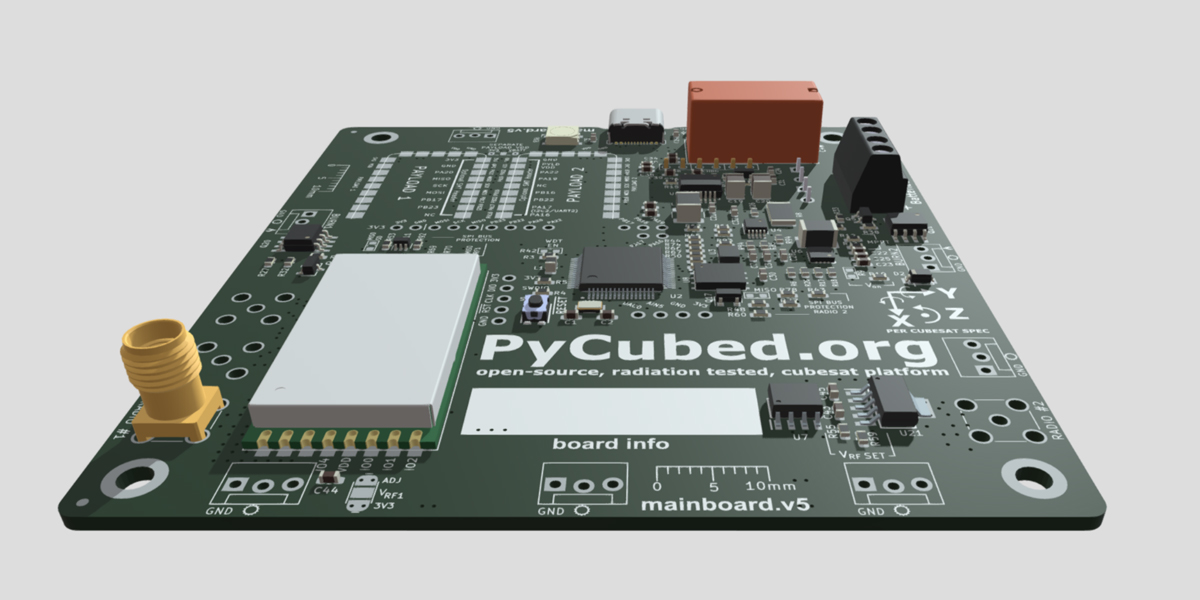
Most first-time missions fail due to early system integration challenges, wiring complexity, and design risk. PyCubed eliminates these issues by combining multiple subsystems that traditionally require separate development:
- Flight computer and microcontroller
- Battery charging and power regulation
- Radio interface and switching
- Fault monitoring and watchdog systems
- Hardware expansion connectors for payloads
This gives student teams a fully functional spacecraft core before the first payload board is assembled.
Step 2: Develop Flight Software in MicroPython
PyCubed runs MicroPython, which simplifies flight software development by using a language familiar to most engineering students. Key benefits include:
- Rapid prototyping and iteration
- Easier onboarding for new team members
- Readable command and control logic
- Reusable libraries maintained by the CubeSat community
Flight software tasks such as detumble control, beaconing, telemetry downlinks, and power state transitions can be developed and tested early in the project timeline.
Step 3: Integrate Payloads Using Open Standards
PyCubed includes standardized mechanical, electrical, and software interfaces enabling quick payload integration. This supports a wide range of experiments:
- Earth observation cameras
- Material exposure studies
- Radio and antenna payloads
- IoT and in-space networking experiments
- Biology and microgravity research modules
Teams can prototype quickly on benchtop hardware before transitioning to flight configurations.
Step 4: Test Continuously Using Real Hardware
PyCubed makes hardware-in-the-loop testing possible from day one. Students can perform:
- Power cycling and safe mode testing
- Telemetry transmission over UHF
- Battery draw and power budget validation
- Functional testing of payload expansion boards
Incremental testing significantly increases mission reliability and reduces launch risk.
When to Transition to the Rook OBC from Blackwing Space
As teams move from classroom development to the final readiness stage for orbital flight, advanced capabilities and manufacturing quality become critical. The Blackwing Space Rook OBC extends PyCubed by providing:
- Drop-in software compatibility with existing PyCubed code
- Stronger power protection and thermal performance
- Modular expansion for advanced payloads and radios
- Full documentation designed for classroom instruction
- Domestic manufacturing aligned with US academic compliance
The development workflow becomes seamless:
- Prototype on PyCubed boards for early mission design
- Transition to the Rook OBC for flight readiness
- Integrate into a Blackwing Space nanosatellite bus for launch
Support for Student Missions
Blackwing Space will offer Rook OBC hardware commercially off-the-shelf at a student-accessible price point (final pricing to be announced). The platform is currently in development and Blackwing Space is onboarding early beta partners including academic CubeSat programs, senior design teams, and research payload groups.
Build With a Flight-Ready Path
PyCubed empowers universities to build missions faster, teach systems engineering effectively, and reduce early development risk. With the upcoming Rook OBC, student teams can continue using a familiar programming model while gaining professional durability and US-based support.
CubeSat missions succeed when complexity is reduced and learning is accelerated. PyCubed provides the starting point. Blackwing Space provides the path to orbit.

Related Articles