PyCubed: How Python and Open Source are Launching the Next Generation of CubeSats
How an open-source, radiation-tested avionics platform is democratizing access to space and reducing CubeSat failure rates
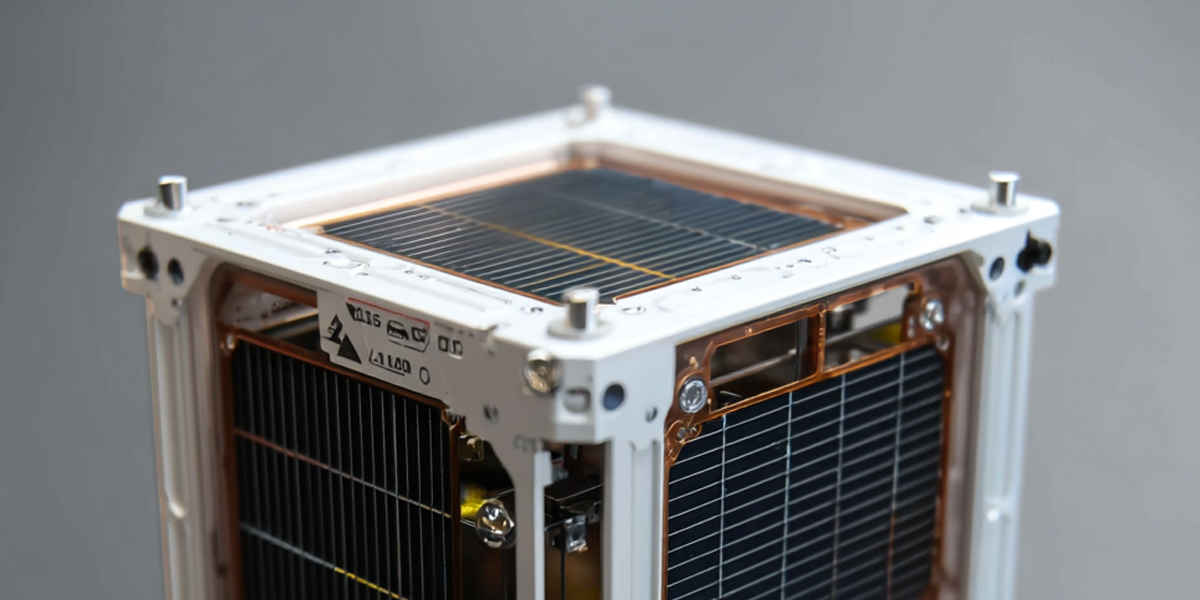
The rapid expansion of the nanosatellite industry, often referred to as Space 3.0, has made orbit accessible to a global community. Yet, this accessibility is marred by a harsh reality: a historical nearly 60% failure rate for first-time CubeSat builders. The complexity of traditional, stove-piped space hardware and software is the primary culprit.
PyCubed, an open-source, radiation-tested avionics platform developed at Stanford University, is the solution. It is designed from the ground up to maximize mission success by integrating essential systems onto a single, reliable board, all programmable in the simple, yet powerful, Python language. PyCubed is fundamentally democratizing the path from lab bench to Low-Earth Orbit (LEO).
Building on this proven foundation, Blackwing Space has developed the ROOK (OBC) On-Board Computer - a next-generation flight computer that inherits PyCubed's reliability while advancing the platform with American-made, automotive-grade components and enhanced capabilities for commercial missions
The PyCubed Solution: All-in-One Avionics for CubeSats
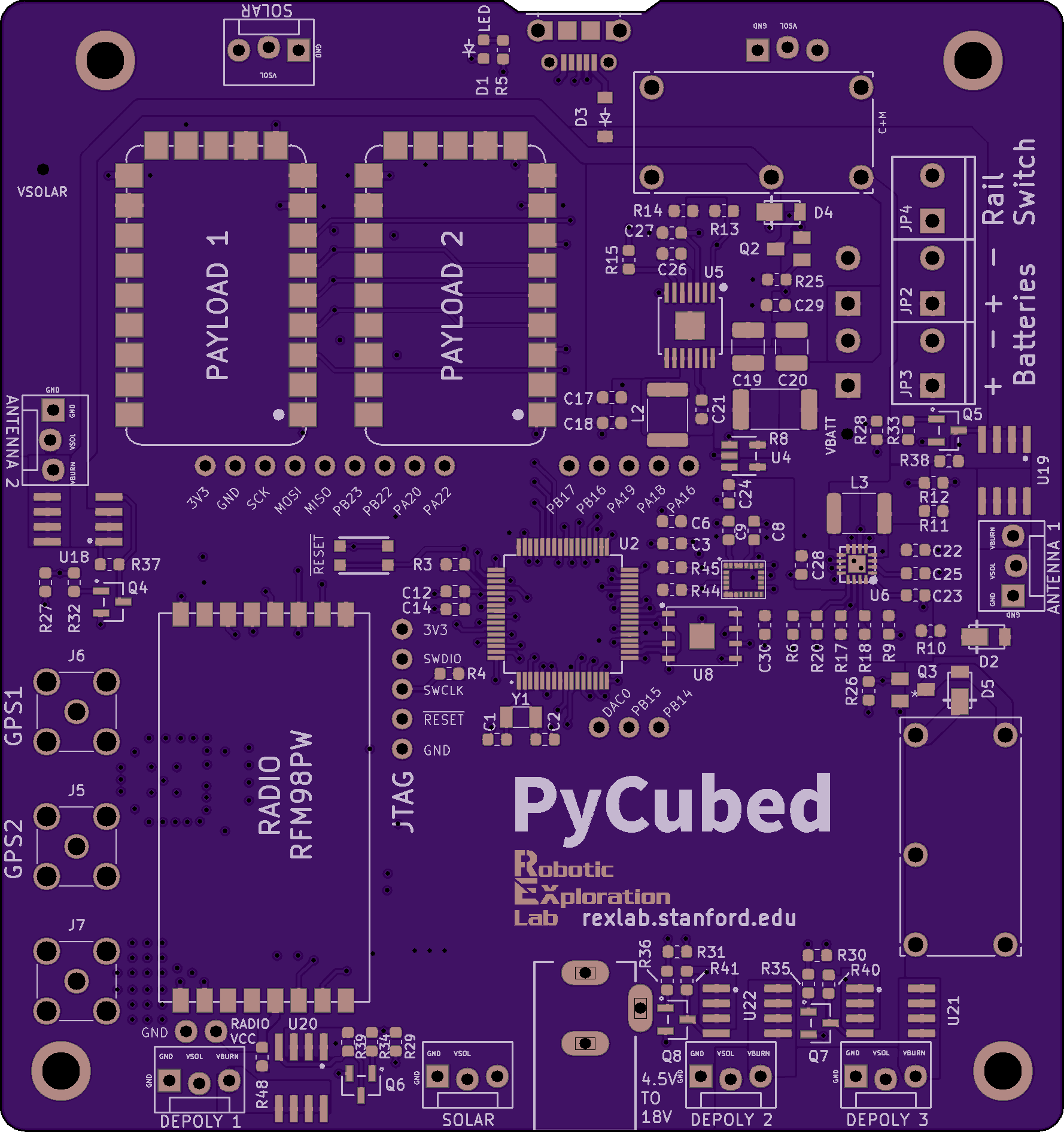
PyCubed operates on a philosophy of consolidation to reduce failure modes. It is a low-cost, all-in-one board that is compatible with the standard PC104 form factor used in most CubeSats. This design eliminates many potential interconnect failures associated with stacking separate Power, On-Board Computer (OBC), and Communications boards.
The single board integrates all critical functions:
- Power Management: Battery charging and regulation of power rails.
- Computing: A powerful microcontroller for command and data handling.
- Communication: Interfaces for UHF/VHF or S-band radios (e.g., OpenLST).
- ADCS & Sensing: Built-in magnetometers, gyroscopes, and temperature sensors for Attitude Determination and Control System (ADCS) functionality.
The board's flexibility is key for researchers, providing four modular payload spots, a modular radio socket, and standard interfaces (UART, SPI, I2C), allowing teams to easily integrate their unique scientific or commercial payloads.
The Python Advantage: Simplifying Flight Software Development
The greatest barrier to successful small satellite missions is often the complexity of the flight software. PyCubed mitigates this by allowing the entire system to be programmed in Python via CircuitPython.
Python's simplicity enables high-level software development, allowing university teams and startups to iterate rapidly and focus on mission objectives rather than low-level C/C++ hardware drivers. The MicroPython runtime environment, which runs the code on a virtual machine (VM), also provides a critical failsafe mechanism. If an interpreted script encounters an error (whether a user bug or a radiation-induced single-event effect), the VM does not halt the processor; instead, it safely executes a reboot or moves to the next failsafe routine, significantly boosting system reliability.
This approach transforms the development process: the CubeSat mounts as a simple "USB drive," allowing developers to edit the flight code as easily as dragging and dropping a text file.
Engineering for Reliability: Radiation Testing and Component Selection
To succeed in LEO, PyCubed had to address two major space environment hazards: Total Ionizing Dose (TID) and Single Event Effects (SEE). The design team established a conservative TID threshold of 10 krad for the mission lifetime and adopted a "Careful COTS" (Commercial-Off-The-Shelf) philosophy, aligning with the principles of using automotive-grade components in space.
Key reliability choices include:
- Power Management (TI): For the critical DC-DC converters, the Texas Instruments (TI) TPS542XX family was selected. Independent testing confirmed these components had a TID tolerance ranging from 15 krad to 20 krad - comfortably exceeding the mission requirement - and were reported to be immune to destructive Single-Event Latch-up (SEL), making them an extremely robust choice for the power subsystem.
- Memory: The use of Everspin MR25H40 MRAM for non-volatile storage offers an impressive TID tolerance of 90-100 krad, protecting mission data against cumulative radiation damage.
- Material Science: The PCB is manufactured using Isola Group's FR408HR laminate, which offers superior resistance to thermal mechanical fatigue compared to traditional FR4, reducing the strain on solder joints caused by repeated thermal cycling in orbit.
- Packaging: The design prioritizes Quad-Flat Packages (QFP) over the more failure-prone Quad-Flat No-Leaded (QFN) packages to enhance resistance to vibration and thermal-induced interconnect failure.
Proven in Orbit: The KickSat-2 Mission Heritage
PyCubed is flight-proven. The platform served as the primary avionics board for the successful KickSat-2 3U CubeSat mission in LEO.
- Success Metric: KickSat-2 successfully operated in orbit for its entire 5-month duration (November 2018 - May 2019).
- Mission Goal Achieved: The PyCubed system successfully commanded and executed the mission's primary objective: the deployment of over 100 femtosatellites (Sprites).
- On-Orbit Validation: Telemetry confirmed that the power and charging circuits functioned flawlessly, consistently bringing the battery pack near full charge.
The successful operation and achievement of all mission objectives on KickSat-2 validates the platform's careful COTS approach and open-source design. This critical mission heritage sets a high bar for accessible space platforms, which can be examined in detail here: PyCubed Flight Heritage: Every Mission That Proved Open Source Belongs in Space.
Democratizing Space: An Open-Source Future
By making the entire PyCubed design - including all schematics, CAD files, justification documents, and qualification data - freely available under a permissive license, the Stanford team has created one of the most valuable resources in the nanosatellite community. This open design encourages external developers to inspect the hardware, contribute code, and adapt the platform for new missions.
PyCubed is now poised to serve as the benchmark for university CubeSats and commercial pathfinders, ensuring that the next wave of small satellite developers starts with a mature, high-reliability foundation. This community-driven approach is key to the overall growth of Open Source CubeSat and Nanosatellite Projects, dramatically reducing the 60% failure rate and accelerating innovation in space.

Related Articles