PyCubed: The Open Source OBC That Changed University Space Programs
Why PyCubed became the most influential open source spacecraft computer and how to actually use it in your mission
Ask any university CubeSat team what flight computer they are considering, and PyCubed inevitably comes up. Developed at Stanford University and flight proven on actual missions, PyCubed represents something rare in aerospace: truly accessible open source hardware that actually works in space.
But there is a problem. PyCubed is not a product you can buy. It is a reference design you must manufacture yourself, creating a significant barrier for teams that want to focus on their mission rather than becoming electronics manufacturers.
This article explains why PyCubed matters, why it is so hard to obtain, and how the new generation of commercial platforms is making PyCubed derived systems finally available to universities, colleges, and startups.
What Is PyCubed and Why Does It Matter
PyCubed is an open source flight computer designed specifically for CubeSats and small spacecraft. Developed primarily by Max Holliday during his PhD work at Stanford University, PyCubed was created to address a fundamental problem in university CubeSat programs: flight computers were either too expensive, too complex, or too proprietary for educational missions.
Traditional CubeSat flight computers from commercial vendors cost $5,000 to $15,000 and often came with closed source software, vendor lock in, and limited documentation. Universities could not learn from or modify these systems, defeating much of the educational purpose of student satellite programs.
PyCubed changed the equation entirely.
Core PyCubed Features
MicroPython and CircuitPython Programming: Instead of requiring teams to master C or assembly language, PyCubed runs MicroPython and CircuitPython. Students can write flight software in a high level interpreted language, dramatically reducing development time and lowering the barrier to entry. Flight code becomes readable and maintainable even as student teams turn over semester by semester.
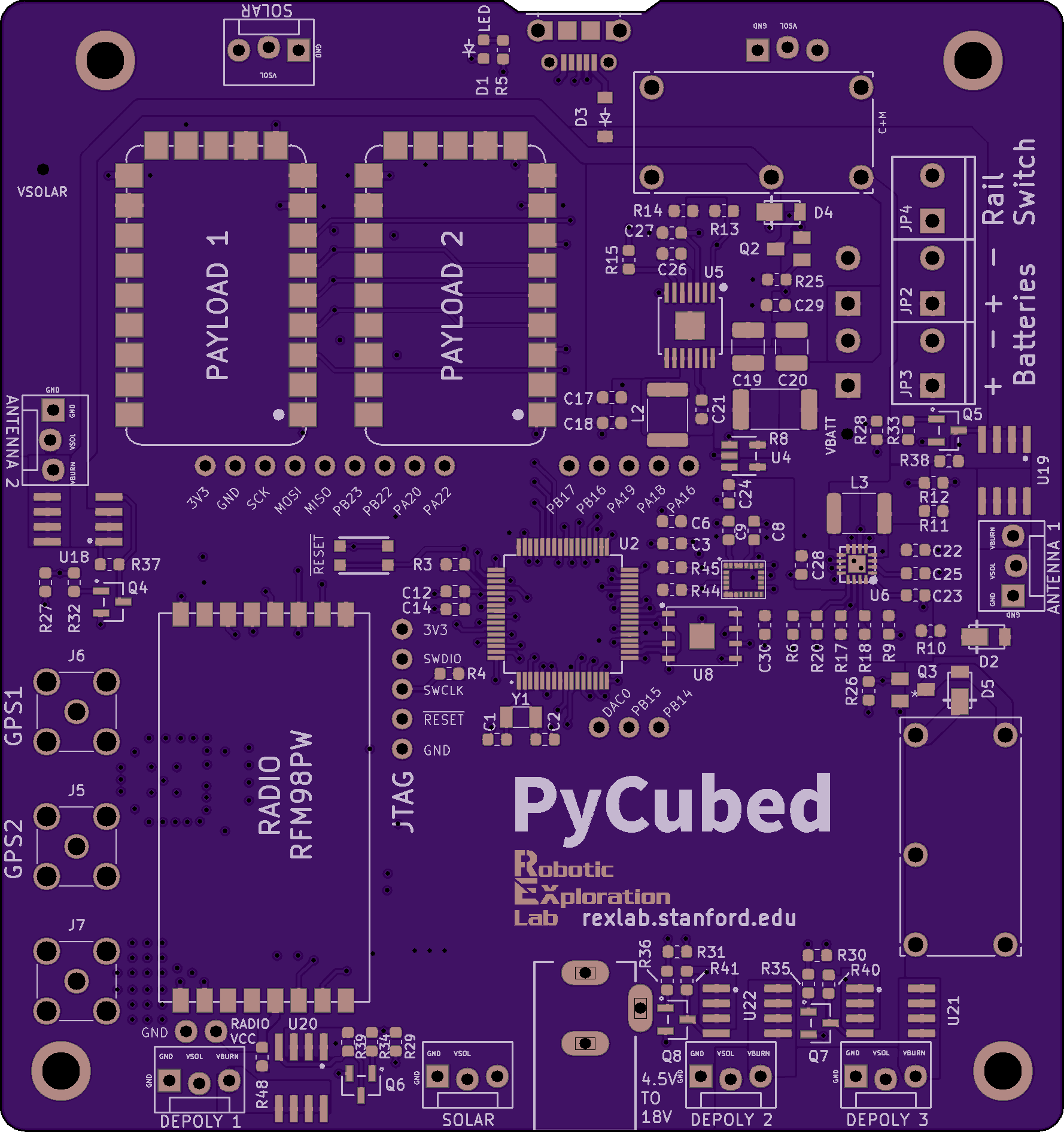
ARM Cortex M4F Microcontroller: PyCubed is built around the SAMD51 ARM Cortex M4F running at 120 MHz with hardware floating point support. This provides genuine computational power for attitude determination, sensor processing, and payload control while remaining power efficient.
Integrated Subsystems: Rather than requiring separate boards for each function, PyCubed integrates power management, battery charging, solar panel interfaces, radio connections, sensor interfaces, SD card storage for data and telemetry, IMU for attitude sensing, and temperature sensors for thermal monitoring.
This integration reduces complexity, saves mass and volume, and eliminates integration debugging between multiple boards.
Completely Open Source: All hardware design files are available in KiCad format. All software is available on GitHub. All documentation is public. Universities can study every aspect of the design, modify it for specific missions, and contribute improvements back to the community.
This openness enables real learning. Students understand not just how to use the system, but how it works at the fundamental level.
Flight Proven Heritage: PyCubed is not a paper design or lab prototype. It has flown on actual CubeSat missions, accumulated real orbital flight data, survived launch environments and space radiation, and demonstrated functionality in genuine operational conditions.
This flight heritage gives university programs confidence that they are building on proven technology rather than experimenting with untested concepts.
Real Missions Using PyCubed
PyCubed flight heritage includes multiple university and research CubeSat missions that have successfully launched and operated in orbit.
V R3X Mission
One of the earliest PyCubed missions demonstrated the platform capability for real space operations including attitude control, telemetry downlink, and payload coordination. The mission validated that Python based flight software could operate reliably in the space environment.
University Research Missions
Multiple universities have adopted PyCubed for CSLI and other launch opportunities. These missions have demonstrated PyCubed reliability across different payloads including Earth observation experiments, communications technology demonstrations, materials science investigations, and biological research.
The consistent success rate shows PyCubed is not a single mission success but a repeatable platform capable of supporting diverse mission requirements.
Technology Demonstration Missions
Startup companies and research labs have used PyCubed for rapid technology demonstrations in orbit. The quick development cycle enabled by Python programming makes PyCubed ideal for proof of concept missions where speed matters more than long duration operations.
Why Universities and Students Love PyCubed
Lower Barrier to Entry
Traditional spacecraft flight software requires expertise in C, real time operating systems, low level hardware interfaces, and complex toolchains. A student must spend months learning these technologies before writing a single line of useful flight code.
PyCubed students can write their first flight software function on day one. Python syntax is intuitive. Libraries handle low level complexity. The learning curve is measured in weeks instead of semesters.
This accessibility matters enormously for university programs where students have limited time and must balance CubeSat work with coursework, research, and other commitments.
Rapid Iteration and Development
Python is an interpreted language. Changes can be tested immediately without recompiling firmware, reflashing boards, or power cycling hardware. This rapid iteration cycle accelerates debugging and feature development.
For university teams working under tight academic calendar constraints, development speed directly determines mission success. PyCubed development cycles are measured in days where traditional systems require weeks.
Educational Transparency
Open source hardware and software means students can learn by reading actual flight proven code and studying real circuit designs. They are not limited to vendor documentation or black box APIs.
This transparency transforms CubeSat projects from assembly exercises into genuine systems engineering education. Students understand the full stack from silicon to orbit.
Community Support
The PyCubed community includes university teams, professional engineers, and the original developers. Online forums, GitHub discussions, and conference presentations provide support and knowledge sharing.
When a student encounters an issue, they are not alone. The community can provide guidance, debug support, and sometimes direct code contributions.
Cost Effectiveness
Commercial CubeSat flight computers cost $5,000 to $15,000. PyCubed component costs for a single board are approximately $150 to $300 depending on quantity and assembly method.
For university programs with limited budgets, this cost difference is mission enabling. Money saved on the flight computer can fund payload development, testing, or extended mission operations.
The PyCubed Problem: You Cannot Actually Buy It
Despite all these advantages, PyCubed has a critical limitation. It is not a commercial product. There is no company selling PyCubed flight computers. There is no purchase order you can submit. There is no tech support hotline.
PyCubed is a reference design. To use it, you must manufacture it yourself.
The DIY Manufacturing Challenge
Manufacturing PyCubed requires significant technical capability and time investment including downloading design files from GitHub, generating manufacturing files for PCB fabrication, sourcing hundreds of components from electronics distributors, either hand assembling boards or arranging pick and place assembly, reflowing solder and inspecting for manufacturing defects, programming bootloaders and initial firmware, testing and validating all subsystems, and debugging any manufacturing or assembly issues.
For an experienced electronics team with fabrication facilities, this process takes 4 to 8 weeks and costs $150 to $300 per board in small quantities.
For a first time university CubeSat team with no electronics manufacturing experience, the process can take months, cost significantly more due to mistakes and rework, and introduce failure modes that delay or cancel entire missions.
Component Sourcing Challenges
PyCubed uses components from multiple suppliers. In recent years, global semiconductor shortages have made some components difficult or impossible to obtain. Lead times stretch to 26 weeks or longer. Prices fluctuate wildly.
Teams that successfully fabricate boards often discover they cannot source critical components for the second board, making redundancy and spares problematic.
No Warranty or Support
Self manufactured boards come with no warranty. If a board fails during testing or in orbit, the team has no recourse. Debugging hardware failures requires oscilloscopes, logic analyzers, and expertise that many university teams lack.
Commercial products include warranties, replacement policies, and vendor support. DIY PyCubed includes none of these safety nets.
Testing and Validation Gaps
Commercial flight computers undergo environmental testing including vibration qualification, thermal vacuum cycles, and EMI EMC verification. Self assembled PyCubed boards typically skip these tests due to cost and facility access.
This introduces risk. A board that works perfectly on the bench may fail during launch vibration or when exposed to thermal extremes in orbit.
Version Control and Documentation Challenges
The PyCubed GitHub repository evolves continuously. Different teams manufacture boards based on different versions of the design files. Troubleshooting becomes difficult when boards do not match any single documented version.
Commercial products have clear version numbers, revision control, and documentation that matches the shipped hardware. DIY builds have none of these guarantees.
The Market Gap: Excellent Technology, No Commercial Availability
This creates a frustrating situation. PyCubed is arguably the best open source CubeSat flight computer design available. It has proven itself in orbit. The community loves it. Universities want to use it.
But practically speaking, most teams cannot actually obtain PyCubed boards without becoming electronics manufacturers themselves.
The result is that many universities either abandon PyCubed in favor of expensive commercial alternatives that offer less educational value, or spend months on manufacturing and debugging that could have been spent on mission development.
Some universities have paid commercial PCB assembly houses to manufacture PyCubed boards in small quantities. This partially solves the fabrication problem but still leaves teams managing component sourcing, version control, testing, and support entirely on their own.
Enter ROOK: PyCubed Goes Commercial
Blackwing Space recognized this gap between excellent technology and practical availability. The result is ROOK, a commercial flight computer derived from PyCubed that brings the benefits of open source design to a productized commercially supported platform.
ROOK is currently in beta development with initial units expected in 2026. Universities, colleges, and startups interested in early access can reach out to discuss beta program participation and timeline.
What Is ROOK
ROOK is a modified PyCubed based flight computer that maintains software compatibility with the PyCubed ecosystem while adding commercial reliability, support, and testing. Think of it as PyCubed productized.
Core Architecture: ROOK uses the same ARM Cortex M4F at 120 MHz processor as PyCubed, ensuring compatibility with existing PyCubed software libraries and flight code. Teams can port PyCubed code to ROOK with minimal changes.
MicroPython Compatible: ROOK runs MicroPython and CircuitPython just like PyCubed. Students get the same rapid development benefits and gentle learning curve that make PyCubed so successful in educational programs.
Integrated Subsystems: ROOK includes power management, battery charging, solar panel interfaces, radio connections, sensor interfaces, data storage, and attitude sensing in a single integrated board.
Enhanced Reliability: Blackwing has modified the PyCubed design to improve manufacturing yield, reduce component sourcing risk, enhance thermal performance, strengthen mechanical durability, and increase radiation tolerance through component selection and layout optimization.
These improvements maintain compatibility while addressing some of the practical limitations discovered during PyCubed flight operations.
Software Compatibility and Migration Path
A critical ROOK design goal is maintaining PyCubed software compatibility. Teams that have developed code for PyCubed can migrate to ROOK with minimal changes. The same MicroPython libraries work. The same hardware interfaces are available. The same development workflows apply.
This compatibility matters for universities that have built institutional knowledge around PyCubed. They can adopt ROOK without throwing away years of code development and student training.
It also means ROOK benefits from the entire PyCubed software ecosystem. Libraries developed by the community, example code from other missions, and tutorials created by universities all work with ROOK.
Commercial Support and Testing
Unlike DIY PyCubed, ROOK comes with commercial support including warranty coverage, technical support during integration, tested and validated hardware, documented and version controlled builds, and replacement policy for failures.
Blackwing will also perform environmental testing on ROOK including vibration qualification, thermal vacuum testing, and functional verification across temperature ranges.
This testing provides confidence that ROOK will survive launch and operate in the space environment, removing a major source of mission risk for first time university teams.
Affordable Pricing
ROOK is positioned as an affordable commercial option, significantly less expensive than traditional aerospace grade flight computers from legacy suppliers while providing commercial support, testing, and reliability that DIY PyCubed cannot match.
Pricing details will be announced as the beta program progresses, but the goal is to keep ROOK accessible to university programs with limited budgets.
Beta Program and Early Access
ROOK is currently in beta development. Blackwing is seeking university partners, startups, and research programs interested in early access to ROOK hardware for upcoming missions.
Beta program participants will receive early access to hardware, discounted pricing for initial units, direct communication with Blackwing engineering team, opportunity to influence ROOK roadmap and features, and support for mission integration and testing.
In exchange, beta partners provide feedback on hardware and software, share lessons learned during integration, and allow Blackwing to reference successful missions in marketing materials.
Universities and startups planning CubeSat missions in 2026 or 2027 should reach out to discuss beta program participation at sales@blackwingspace.com.
Why Open Source Flight Computers Matter for Universities
The success of PyCubed and the development of commercial derivatives like ROOK highlight a broader truth about university CubeSat programs. Open source hardware and software fundamentally enable better educational outcomes than closed proprietary systems.
Students Learn Real Systems Engineering
When students can read flight proven source code and study actual circuit schematics, they learn real systems engineering rather than just calling vendor APIs. They understand trade offs, design decisions, and failure modes at a deep level.
This depth of understanding creates better engineers. Graduates who have worked with open source spacecraft systems bring valuable skills to their first jobs in aerospace industry.
Programs Build Institutional Knowledge
Proprietary systems create vendor lock in and black box dependencies. When key students graduate, institutional knowledge leaves with them if the only documentation is vendor user manuals.
Open source systems enable universities to build lasting programs. Code and design knowledge stays with the institution. New students can learn from previous teams. Missions build on each other rather than starting from scratch.
Innovation Happens Faster
When teams can modify and extend their flight computer, innovation accelerates. A student with a novel idea for attitude determination can implement it directly. A research payload requiring unusual interfaces can be accommodated.
Closed systems force innovation into the narrow channels defined by vendor product offerings. Open systems unleash creativity.
Cost Enables More Missions
Lower cost flight computers mean universities can fly more missions. Instead of one satellite per decade, programs can launch missions every 2 to 3 years. Students get hands on experience with real flight hardware instead of just studying past missions.
Frequency matters for education. The more missions a program flies, the more students gain practical experience and the better the program becomes at actual space operations.
Use Cases: Who Should Consider PyCubed or ROOK
First Time University CubeSat Programs
Universities launching their first CubeSat program benefit enormously from PyCubed or ROOK. The gentle learning curve, excellent documentation, and community support reduce the risk of first mission failure.
Starting with proven open source technology allows teams to focus on their specific payload or research question rather than reinventing basic spacecraft functions.
STEM Education Programs
High schools, community colleges, and undergraduate programs benefit from the educational transparency of open source platforms. Students can progress from simple blinking LED experiments to actual flight code using the same hardware and software stack.
The affordability of PyCubed derived systems makes it realistic for educational institutions to maintain multiple development boards so every student team can work hands on rather than taking turns with a single expensive unit.
NASA CSLI Applicants
Universities applying for NASA CubeSat Launch Initiative missions need flight proven affordable platforms to build competitive proposals. PyCubed heritage missions demonstrate the platform capability, making CSLI applications more credible.
Commercial availability of ROOK simplifies budget justification and eliminates the manufacturing time uncertainty that can derail CSLI applications.
Startup Technology Demonstrations
Early stage space companies need to demonstrate technology in orbit quickly and affordably. PyCubed and ROOK enable rapid development cycles where flight software can be written and tested in weeks instead of months.
The Python development environment is particularly valuable for startups where engineering time is limited and speed to orbit determines fundraising success.
Research Payloads and Experiments
Materials scientists, biology researchers, and instrument developers need simple reliable bus platforms that support their research payloads without becoming the focus of the mission. PyCubed and ROOK provide plug and play spacecraft functions so researchers can focus on their experiments.
The open interfaces make it straightforward to integrate custom sensors and instruments without reverse engineering proprietary communication protocols.
International Collaboration
Open source platforms facilitate international collaboration on student satellite programs. Teams in different countries can work with the same hardware and share code without export control complications that plague proprietary systems.
For universities with international student populations, PyCubed and ROOK enable full team participation without triggering ITAR restrictions on technical data sharing.
Comparison: PyCubed and ROOK vs Traditional Flight Computers
Cost Comparison
Traditional Commercial Flight Computers: $5,000 to $15,000 per unit with closed source software, limited documentation, and vendor lock in.
DIY PyCubed: $150 to $300 in component costs but requires manufacturing expertise, time investment, and carries no warranty or support.
ROOK: Positioned as affordable commercial option with full support, testing, and warranty at a price point accessible to university programs.
Development Speed Comparison
Traditional Systems: Steep learning curve for C programming and RTOS. Months to first functional code. Limited debugging tools.
PyCubed and ROOK: Students can write first functional code on day one using Python. Rapid iteration with immediate testing. Rich debugging and logging capabilities.
Educational Value Comparison
Traditional Systems: Black box with vendor documentation. Students learn to use APIs but not understand system design.
PyCubed and ROOK: Complete transparency. Students study flight proven designs and learn actual systems engineering. Can modify and extend functionality.
Support and Reliability Comparison
Traditional Systems: Vendor support included but often slow. Expensive replacement units. May be discontinued leaving programs stranded.
DIY PyCubed: Community support only. No warranty. Self repair if failures occur.
ROOK: Commercial support with warranty. Direct access to Blackwing engineering. Tested and validated hardware.
Technical Deep Dive: What Makes PyCubed Architecture Special
The Power of Python in Space
Traditional spacecraft run compiled C code on bare metal or lightweight RTOS. This provides maximum performance but requires expertise and slows development.
PyCubed runs interpreted Python on top of a lightweight kernel. This introduces small performance overhead but provides enormous development velocity benefits including rapid prototyping and testing, rich standard library for common functions, interactive debugging via serial console, on orbit code updates and bug fixes, and readable maintainable code that survives team turnover.
For university missions with 2 to 3 year lifetimes and limited power budgets, the ARM Cortex M4F provides more than enough computational capability even with Python overhead.
Integrated Sensing and Telemetry
PyCubed includes integrated IMU for attitude sensing, temperature sensors for thermal monitoring, current and voltage sensing for power telemetry, and SD card for data logging and redundant storage.
This integration means basic spacecraft telemetry is available immediately without additional hardware or complex interfacing. Flight software can log detailed data for debugging and anomaly investigation.
Radio and Communications Interface
PyCubed provides standardized interfaces for common CubeSat radios including UART for simple radios, SPI for higher performance modules, and I2C for auxiliary sensors and peripherals.
Teams can select radios based on mission requirements and budget rather than being locked into specific vendor communications modules.
Power Management and Battery Charging
Integrated power management handles solar panel maximum power point tracking, battery charging with temperature compensation, load switching and current limiting, and voltage regulation for multiple rails.
This removes one of the most complex subsystems from the university team scope of work, allowing them to focus on mission specific challenges.
Migration Path: From PyCubed Development to ROOK Flight
For universities currently developing with DIY PyCubed, ROOK provides a clear migration path to flight hardware.
Development Phase: Use DIY PyCubed
Teams can develop and test initial flight software using self assembled PyCubed development boards. The low cost enables multiple development units so every student can work hands on.
All code development, interface testing, and algorithm validation can happen on DIY PyCubed boards.
Qualification Phase: Switch to ROOK
When ready for environmental testing and flight qualification, teams switch to ROOK hardware. The software compatibility means code ports directly with minimal changes.
ROOK units go through environmental testing to qualify for launch. DIY development boards provided the learning platform, while ROOK provides the flight qualified hardware.
Flight Phase: ROOK with Commercial Support
Flight units are ROOK with full commercial support. If anomalies occur, Blackwing engineering provides troubleshooting assistance. If hardware fails, warranty replacement is available.
This development to flight path gives universities the educational benefits of open source PyCubed during development while providing mission assurance and support during the critical flight phase.
The Future of Open Source Spacecraft Electronics
PyCubed represents just the beginning of open source spacecraft hardware. The success of the platform proves that universities and students can develop professional quality space systems when given accessible tools and good documentation.
The emergence of commercial products like ROOK based on open source designs shows a sustainable path forward. Open source provides the educational foundation and innovation engine. Commercial productization provides reliability, support, and scale.
This combination benefits everyone. Universities get affordable well supported hardware. Students learn from transparent open systems. The open source community benefits from increased adoption and feedback. And commercial suppliers build sustainable businesses serving an underserved market.
Getting Started with PyCubed or ROOK
For Universities Considering DIY PyCubed
If your university has electronics manufacturing capability and wants the educational experience of building PyCubed from scratch, the design files and documentation are available on GitHub. Budget 4 to 8 weeks for fabrication and testing.
Be realistic about manufacturing challenges and plan accordingly. Build extra boards for testing and spares. Allocate time for debugging and rework.
For Programs Wanting Commercial Solutions
If your program wants PyCubed benefits without manufacturing burden, contact Blackwing Space about ROOK availability and beta program participation.
Current timeline targets initial ROOK units in 2026 for beta partners. Programs with launches planned for late 2026 or 2027 should reach out now to discuss timelines and requirements.
Questions to Ask
When evaluating PyCubed or ROOK for your mission, consider these questions:
- Do we have electronics manufacturing capability or do we need commercial hardware?
- What is our timeline from funding to launch?
- How much programming experience does our team have?
- What level of commercial support do we need?
- What is our budget for flight computer hardware?
- Do we need environmental testing and qualification?
- Are we willing to participate in beta programs for early access?
Why PyCubed Changed University CubeSat Programs Forever
Before PyCubed, university CubeSat flight computers were either prohibitively expensive commercial products or risky completely custom designs. PyCubed created a third option: proven open source hardware that students could understand, modify, and build upon.
The impact has been substantial. More universities are flying CubeSats. Student learning outcomes have improved because teams understand systems at fundamental levels rather than just using vendor APIs. Mission costs have decreased, enabling more frequent flights. And the community knowledge base continues to grow as teams share code and lessons learned.
PyCubed proved that open source spacecraft electronics can be done right. Flight proven. Well documented. Genuinely accessible.
The next chapter is commercialization. As platforms like ROOK make PyCubed technology available as supported products, the benefits of open source design reach even more teams. Universities get reliability and support. Students still get transparency and educational value. And the space industry benefits from a larger more diverse community of innovators.
If you are planning a university CubeSat mission, startup technology demonstration, or research payload flight, PyCubed and its commercial derivatives deserve serious consideration. The combination of proven heritage, educational transparency, development speed, and affordability is unmatched in the CubeSat flight computer market.
Space access is democratizing. Open source platforms like PyCubed and commercial products like ROOK are making it happen.
Ready to discuss PyCubed or ROOK for your mission? Contact Blackwing Space to explore ROOK beta program participation, discuss software compatibility and migration paths, and plan your path to orbit with proven open source technology: sales@blackwingspace.com
Learn More:

Related Articles